Once again, we have a great piece from our guest author, Nathan H.
========================================================
Once again, we have a great piece from our guest author, Nathan H.
========================================================
This piece may not be for everybody. That’s fine. I’m throwing it out there like a fish lure. Let them bite who will.
If I had to describe the general attitude among Christians with a single word, I would probably use “frustrated.” Many Christians have unmet expectations that wriggle like a pebble in their shoe, whether they’re minor letdowns or devastating disappointments. Behind every soapbox and impassioned sermon lies a gnawing ache that something is wrong.
I begin this piece by saying that something is wrong, and it’s happened before. Let’s call it the Age of Ichabod. There’s an over-arching story in the Bible as told in the narrative of Samuel in which the birth of a boy named Ichabod marks a horrid dry spell in Israel’s history. This story lays out a particular principle that needs to be remembered and applied today.
In 1 Samuel 4, we see a transition of sorts. Previously in the book, we are told of the phenomenal events surrounding the birth and childhood of Samuel; he was called by God at an early age to replace the corrupt and inept house of Eli as the spiritual leadership of Israel. By the fourth chapter, the Israelites were again at war with their old-time rivals, the Philistines, and they were losing.
“Why did God let us lose?” they ask one another. Rather than dwell on this question and possibly admit their need for repentance, they instead decide to force God’s hand by sending the Ark of the Covenant before them into battle. The Ark was where God’s presence was manifest on earth, so surely they could manipulate God into doing what they wanted—what they needed.
The national indifference toward God was a result of the leadership. We are told in 1 Samuel that the high priest, Eli, had two sons who were beyond wicked, yet he did not discipline them or even remove them from service in the tabernacle. It is no wonder that the troops had minimal regard for God when His own high priest displayed so little.

They thought God would do what they wanted if they played their cards right. They thought wrong.
Not only did Israel lose the next battle, but they lost the Ark to their enemy, and suffered almost ten times the number of casualties—including Eli’s evil sons. When a survivor ran back to Shiloh, the city where the Tabernacle was permanently set up in the Promised Land, his tale was so shocking that Eli fell off his high chair and broke his neck. What’s more is that his son’s pregnant wife went into distressed labor at these turn of events, and died giving birth to a son. The midwife, astonished that Eli, his sons, and the mother were dead, and that the Ark was in the possession of the enemy, called the boy Ichabod, saying, “The glory has departed from Israel!”
The Age of Ichabod had begun.
The name comes from the Hebrew *qabod, meaning “glory.” Hebrew glory was not just the idea of greatness and grandeur, but something more inspiring, like radiance and splendor. It was with this meaning in mind that Paul said a woman’s hair is her “crowning glory.” Israel lost her glory; she had just been scalped. It’s a shame that the grandson of Eli had to bear the name which commemorated the new era.
The absence of the Ark was more than just cosmetic, however. The Ark was the centerpiece to Tabernacle ministry. Sacrifices of praise could be made without it, as well as some ceremonial rituals as administered by the Levites and priests, but the sin offering on the Day of Atonement required the Ark. Without it, Levitical observances would be little more than show, as the soul of the rituals and ceremonies would be absent. It’s essentially for this reason that modern Jews do not maintain the need for sacrifices today—how could they without the Ark?
Samuel finds himself thrust into the forefront of national turmoil. Even though the Ark was returned to Israel within seven months, it wound up in the custody of a steward rather than in the Tabernacle. Samuel was raised in the instruction of Eli and made sacrifices, so it seems that he continued with the priestly observances without the luster of the Tabernacle proper.
Even though the conduit of God’s manifest presence was returned to Israel, the glory had not!
Samuel compelled the Israelites to dispose of their idols and return to faithful devotion to the LORD God. He established an itinerate circuit, so as to minister to the entire nation, rather than sitting on his haunches at home all year long, expecting the people to come to him. Although the glory was missing, there was peace.
As Samuel grew old and gray, however, the people began to desire a human king. Samuel rebuffed this at first, but God told him to relent. “They have not rejected you as judge, Samuel, but they have rejected Me as King. Give them a king.”
What the people got was Saul. He was a head taller than any man in the land, and he looked good in a parade. When the Philistines made war against Israel yet again, the people were happy to follow Saul into battle.
Saul became arrogant, though. God had made him king, and it went to his head. Samuel’s ways were out-moded. Things were much better Saul’s way, Saul thought. He was eventually tormented by demons, and was arguably driven to madness.
Along comes David.
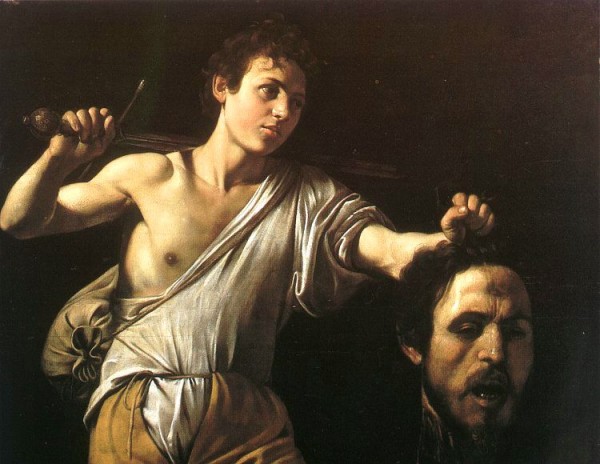
When the picture-perfect king couldn’t slay a Philistine giant, a shepherd boy chosen by God does what the king’s army couldn’t—trust in God.
Despite Saul’s position, he had no authority. He sacrificed it when he went his own way. David, though a runt, won the day because he stood on his faith in God.
For a time, David and Saul were copacetic. Saul recognized David’s potential, and even though the nation’s admiration sparked jealousy, Saul took a liking to David…except for the times when he tried to have David killed.
In the end, Saul was destroyed by his own pride. Pinned down in a rocky battlefield, he fell on his sword rather than admit defeat in a battle he thought to win in his own strength.
When David finally became king, his reign was so diametrically opposed to that of Saul’s that you could barely give them the same title. Saul was just like the other kings, which is what the people wanted. David was a man after God’s own heart, and despite his faults and failures, he put God first in everything he did. Israel flourished as a result.
Yet the glory had not returned.
In 2 Samuel 6, some twenty years after its capture and nonchalant return to Israel, David had the Ark of the Covenant returned to the Tabernacle, which was erected in the newly conquered capitol, Jerusalem.
David wore nothing but an ephod while dancing for joy in the streets. He wasn’t dancing because the priests were singing his favorite song. His dance wasn’t a display of worship to intimidate all of the shy people.
David danced because the manifest presence of God returned to the heart of Tabernacle ceremony. The soul of the nation was back. There was actually a point now to going through the rigorous motions of Levitical ceremony.
How does any of that relate to today?
We have four components in this narrative.
1) House of Eli
2) House of Samuel
3) House of Saul
4) House of David
Let’s say the House of Eli is the old generation. Compromise had set in during Eli’s ministry. He valued getting along more than righteousness. As long as everybody was with the Program, then why rock the boat by upholding justice (and not letting his sons sleep with women waiting in line at the Tabernacle)?
In order to function better, concessions have been made with the world. A truce has been struck with the kingdom of darkness—it is given its space over there, the church is given her space over here, and everybody goes on in a tenuous balance.
God does not jive with this. He ends Eli’s ministry, eliminates his successors, and removes the Glory.
Samuel is raised up. He is trained in the same ministry as Eli, but he has integrity. In fact, he is never recorded as having done anything wrong, or to have displeased the LORD—“The LORD was with him, and did not let his words fall to the ground.”
Yet the glory did not return through Samuel.
Let’s say the House of Samuel is the response to the old generation; a ‘tweener generation, for lack of a better term. This response does everything asked of the LORD, yet there is no glory. This is perhaps the bulk of the frustration seen within the church; sincere and devout believers who cannot understand why the situation, whichever situation, remains so. Why isn’t there change? Why isn’t progress made?
It was not the fault of Samuel; it was the people. They want Saul.
Let the House of Saul be the response to Samuel. Ineffectual ministry must be discarded and something new brought forward, right? Let’s try what everyone else is doing. Seems to work for them, right? What begins with genuine ministry is twisted by hubris into something that’s counterproductive, and possibly hostile to the goals of God.
The House of David is the answer to Saul and Samuel. Samuel passes the torch to David, but instead of following the traditional way, David does something new. He fights. Rather than trying to persuade a corrupt institution to do something contrary to its nature (sincerely repent and humbly submit), David takes the torch and performs that institution’s mission himself. He doesn’t need the people’s permission, for they at times love and hate him, and while he took refuge and support from the priests as they made available to him, David’s hope was in God, whether as a shepherd, a general, a rebel commander, or a king.
David made war against Israel’s enemies even while called an enemy of Israel. When he was edged outside the confines of Israel’s establishment, he simply continued to do what he was called to do, and his calling made room for him. By doing what the king was supposed to do, he was made king.
In our time, we’ve witnessed the death throes of Eli, and we’re experiencing the conflict between Samuel (the alienated, frustrated remnant) and Saul (the delusional prima donnas). The only difference is that Samuel is reluctant to anoint David at this time.
For the Age of Ichabod to end, David must come. Rather than purifying the old Eli ministry, Samuel must overcome his fear of Saul (or seeing another Saul rise up in his place) in order to launch David forward.
This applies directly to us, here and now.
In order to attain the peace and prosperity that many envision in the future Solomon generation, we must face the battle as David. We must embrace rejection and revulsion, not resent it like Samuel; we must stand boldly in the face of opposition like David, not cower behind ulterior motives like Samuel; we must honor God in all we do, and not follow our own wisdom and passions like Saul. We must whole-heartedly follow God because we love him, as David did, not play-act devotion because that’s what’s expected of us like Saul did.
The contrasts can go on, but the message is clear: Samuel did fine during the Age of Ichabod in his obedience, but the nation did not. We need to stop trying to resurrect Eli. Ichabod will endure, unless we risk the wrath of Saul and the world itself to become David.
Ichabod was so named because the Ark left the Tabernacle. There can be no glory where there is no presence. Seek the presence of God as if He’s a real person, utilize His wisdom and words instead of your own, stand where others flee, and trust in Him whether you’re personally confident, terrified, or despondent. In this, we defy the Ichabod state, the lack of glory, by reaching out of this world and into the next.
In this Age of Ichabod, I want to be a David. I want to bring finality to the war of attrition against the church and to see the glory return to the House of God. I want to leap for joy because God’s manifest presence has returned to the heart of His people, because then I would know that the frustration of all the Samuels and the distractions and self-destructions of the Sauls will be at an end, and the way will be clear for the Solomon generation (Solomon, whose name means Peace) built upon the splendor and radiance of God’s returned glory.
Who's with me?


 I share this story with you all, not to show how righteous or amazing I am (because such a statement would be a far cry from the truth!), but to encourage you, our readers, to look to God for all things. He will always provide- I have learned this truth in my own life, and will continue to learn this lesson in greater and bigger things.