
 This week, our guest author is Nathan. Most recently a youth pastor, Nathan is being positioned more and more for ministry to and within the Body of Christ in a much greater capacity. His personal stylings, however, seem to shatter a great deal of preconceived notions regarding what a minister of the Gospel should be: We see the list within the Pauline letters, but mankind has added such a great deal to the concept of "minister," that the two are barely recognizable.
Ironically, it was this disproportionate emphasis on one form or another of "use" within the Church that led to this first article, and it is so very much on point, I feel it would be nearly criminal not to feature it here on WarriorSoul.
Without further ado... Five-Fold Calibration.
=+=+=+=+=+=+=+=+=+=+=+=+=+=+=+=+=+=+=+=+=+=+=+=+=+=+=+=+=+=+=+=+=+=+=
There's a passage of the Bible that many scholars have debated about for awhile now.
And he gave some to be apostles; and some, prophets; and some, evangelists; and some, pastors and teachers;
for the perfecting of the saints, unto the work of ministering, unto the building up of the body of Christ:
till we all attain unto the unity of the faith, and of the knowledge of the Son of God, unto a fullgrown man, unto the measure of the stature of the fulness of Christ:
that we may be no longer children, tossed to and fro and carried about with every wind of doctrine, by the sleight of men, in craftiness, after the wiles of error;
but speaking truth in love, we may grow up in all things into him, who is the head, even Christ;
from whom all the body fitly framed and knit together through that which every joint supplieth, according to the working in due measure of each several part, maketh the increase of the body unto the building up of itself in love. ~Ephesians 4:11-16 (ASV)
Paul is the king of run-on sentences, so we'll just leave it there.
There's a moderate debate as to whether or not this passage applies today, and I feel obliged to speak to that before continuing.
Starting from the last verse, we can note a few things:
- the Body makes increase by its inner workings of love;
- the inner workings of love within the body are in due measure of each part;
- the Body is framed and knit together, every part, in Christ.
In other words, the Body of Christ can only be the Body of Christ if it's doing Christ's work as Christ prescribes at Christ's direction. I cannot rightly call someone else's body my own body if it's not attached to me and follows its own commands, or the commands of someone else.
In the next-to-last verse, we read that the Body speaks the truth in love in order to mature in Christ. Maturation means growth, not decline; increase, not decrease.
By now we've back-tracked to verse 14. The Body is expected to become an adult in terms of purpose and wisdom, and not confused as a child or adolescent. There ought to be clarity and depth in the Body's ministry, not shallow ambiguity.
Verse 13 outlines the requirements for reaching adulthood:
- unity of faith (we all share the same belief);
- complete knowledge of the Son of God (Jesus is more than a name);
- fully measured up to the full stature of Christ (we do everything Jesus did).
In spite of many victories, achievements, and lives given to devotion and service, even after 2,000 years, I don't think anybody can say that the Body of Christ at large has attained unity of faith, complete knowledge of Jesus, and the full measure of Christ's stature on earth. We're just not there yet.
Where does that leave us? Verse 12 outlines the sorts of things the Body can do to exercise itself:
- perfecting the saints;
- ministry;
- building up the Body.
Sounds a little redundant, but we're about to go into overtime after 2,000 years and we still haven't gotten it right, so maybe we need to look at how the Bible says it's supposed to be done. That takes us straight to verse 11.
Christ gave apostles, prophets, evangelists, and pastors, teachers. For what purpose? Let's retrace our steps:
 Apostles, prophets, evangelists, pastors, and teachers were given in order to:
- Perfect the saints;
- Minister to the world;
- Build up the Body;
- Attain unity of faith;
- Attain complete knowledge of Jesus;
- Attain the full measure of the stature of Jesus.
When we see spiritual offices at work to accomplish those things, it is then that we see the Body increase its inner workings of love, a balance where every member does their part, and Christ is actually followed rather than mentioned.
The question is not whether apostles, prophets, evangelists, pastors, and teachers ought to still exist, but rather what they ought to look like and whether or not the Body is in a place to utilize all five.
Before we can really get into what a fully utilized five-fold ministry looks like, we'll have to look into church structure.
Ecclesiology is the study of church structure, from the Greek ekklesia for "church." The ecclesiology of Christianity has undergone a number of transitions over the centuries.
When the Roman Empire decided to reverse its policy of persecution toward Christians by virtue of the maxim "if you can't beat'em, join'em," there was a priesthood erected to service the imperial religion across the known world. Up to this point, there was not any position of 'priest' within Christian ecclesiology. Before the fourth century, church structure followed the advice given by Paul to his protoge, Timothy. Since the fourth century, every major ecclesial tradition has been in response to the Roman Catholic tradition.
In the New Testament books 1 Timothy, 2 Timothy, and Titus, known collectively as the Pastoral Epistles, Paul identifies several key positions in church structure, but not once does he refer to either apostles, prophets, evangelists, pastors, or teachers. Not once, save to refer to himself as an apostle, but more on that later.
Paul referred to, at most, only three positions of church structure:
- the daikonos;
- the episkopos;
- the presbyteros.
The deacon, the overseer/bishop, the elder.
A "daikonos," or deacon, is literally a servant, and the position was instituted by the apostles in the book of Acts.
Now in these days, when the number of the disciples was multiplying, there arose a murmuring of the Grecian Jews against the Hebrews, because their widows were neglected in the daily ministration.
And the twelve called the multitude of the disciples unto them, and said, It is not fit that we should forsake the word of God, and serve tables.
Look ye out therefore, brethren, from among you seven men of good report, full of the Spirit and of wisdom, whom we may appoint over this business.
But we will continue stedfastly in prayer, and in the ministry of the word.
And the saying pleased the whole multitude: and they chose Stephen, a man full of faith and of the Holy Spirit, and Philip, and Prochorus, and Nicanor, and Timon, and Parmenas, and Nicolaus a proselyte of Antioch;
whom they set before the apostles: and when they had prayed, they laid their hands upon them.
And the word of God increased; and the number of the disciples multiplied in Jerusalem exceedingly; and a great company of the priests were obedient to the faith.
And Stephen, full of grace and power, wrought great wonders and signs among the people. ~Acts 6:1-8 (ASV)
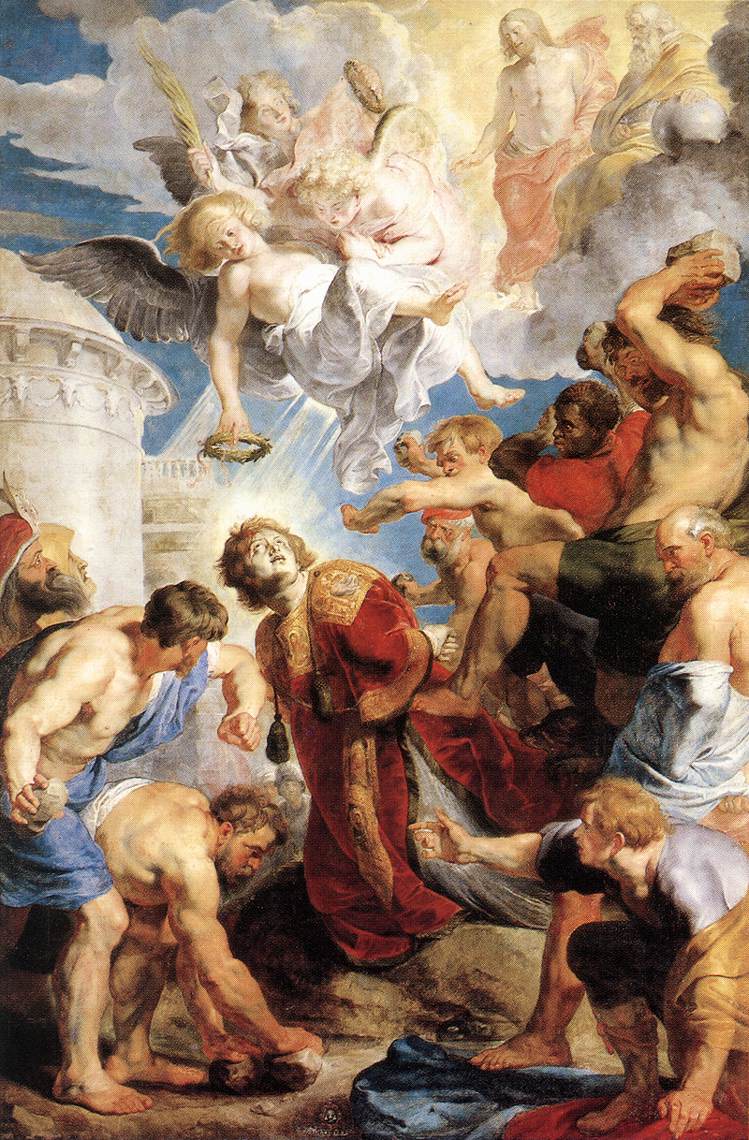
Deacons were needed in the first church in Jerusalem because the apostles were so busy with charitable administration that they were not able to spread the Good News very effectively. Incidentally, is this not the state in which many American churches find themselves, where the Church Game has taken over and replaced the Gospel of the Kingdom? The solution was to select seven men of faith and character to administer charity to the Body so that the apostles could commit themselves to prayer and preaching.
In other words, deacons were tasked with the nitty-gritty stuff.
What is often not emphasized is that Stephen, a "mere deacon," was noted for being full of grace and power, and was known for working great wonders and signs among the people--not small wonders, but great ones.
Although Paul advised elders to be in charge of teaching (in fact, being apt to teach was one of his requirements for eldership), ministry was not restricted to them. Deacons were clearly used by God in ways other than the mundane tasks of their church positions.
This means that there is an assumed distinction between somebody's spiritual calling and their church position. In other words, just because somebody has the title of "pastor" does not mean they are actually gifted or called as a pastor. "Pastor" is simply the nominal title used for a bishop/overseer/head elder in modern American Protestant traditions. Whether one says bishop, pastor, reverend, or father, the distinction is one of church structure--a physical position--rather than an office or gift--a spiritual position. The confusion between a "physical pastor" who leads an American 501(c)3 not-for-profit church organization and an actual pastor gifted with the office of spiritually mentoring believers has lead to obscurity in spiritual offices and an imbalance in how they're perceived and even administered.
Common results are some rather distressfull circumstances for Christian leaders who attempt to fit an ecclesiological mold that was not fashioned with them in mind. Here is an agreeable example: a believer who feels called to the ministry is pigeon-holed into the role of a pastor when they are spiritually gifted as an evangelist; somebody who is moved to spread the Good News is forcibly leashed to a pulpit when he is called to the frontier, whether in domestic society or abroad. This creates disparity in his ministry and in his discipleship, as he is not able to relate effective experience to others when the time comes for him to pass the torch.
A more controversial example is someone who is called as a prophet or apostle, but they are part of a church tradition which does not recognize either of those gifts and ministries as valid, and therefore he commits himself to a life of pastorship in order to serve God and the church. This means that someone who is called by God to the unique position of prophecy is instead prompted to mentor young believers in spiritual living--something within his ability but not necessarily within his range of gifts. Many 'pastors' grow frustrated and burn out because they've danced to the beat of the wrong drum.
Don't get me wrong--every believer has the ability to evangelize, mentor, and hear from God. It might be buried, but it's there as part of their spiritual birthright. What I am saying is that when the ability is supernaturally enhanced, it's advanced to the level of 'gifting.'
I am exercising my ability to evangelize when I give my testimony, but when the word of that testimony is enhanced by the witness of the Holy Spirit, it becomes recognized as a gift. Somebody whose life revolves around a particularly strong gifting would be a strong candidate for an office, which is to say that a prophet would be correctly defined by somebody whose ability to hear from God is supernaturally enhanced to the degree that it shapes their life differently from another believer who has a heart for the lost.
That is the difference between someone who is called by God to be a pastor and someone who chooses to be a pastor because the other options are limited by ecclesiological tradition.
So, not only is there a division between church positions, such as bishops/elders (remember, the title of "pastor" falls into this category) and deacons, and spiritual offices, such as apostles, pastors, and teachers, but there are degrees of spiritual gifts that separate a disciple with spiritual gifts from an office of ministry.
Church positions and spiritual offices are on different spectrums. This means that somebody can be a pastor without having a church position of 'pastor,' while someone with the title of 'pastor' isn't necessarily called as one.
This is demonstrated by Paul introducing himself by a spiritual office and not a physical position--an apostle has a spiritual realm of authority, whereas an elder/overseer/bishop has a specific physical authority. Paul had authority in churches that he founded, but whenever he attempted to minister in Jerusalem, he was stymied--he was veering away from his realm of spiritual authority by meddling in a physical region outside of his spiritual calling to Gentiles.
Furthermore, the concept of a laity (church members who just sit there) is useful only for head-counters and cattle-herders. When Paul refers to a 'congregation,' there is absolutely nothing to suggest that he is not assuming that the local body is not comprised of full-fledged and fully devoted disciples. That is to say, regardless of one's position in a church body, a believer ought to be pursuing their personal calling in Christ and living out their spiritual destiny. Remember, Stephen was chosen as a deacon because of the grace and power on his life; grace and power did not come as a result of his position.
If one's spiritual destiny is not being revealed, developed, or in any way activated, then there is an imbalance that can only be corrected by a five-fold calibration.
This means that regardless of how a church is structured in terms of leadership (deacon boards, elder boards, leadership committees, etc., etc.), the actual spiritual growth of the Body depends on the balance of the five-fold ministry. A church which over-emphasizes evangelism to the detriment of discipleship is going to marginalize the potential pastors in their midst; a church which over-emphasizes teaching to the detriment of prophetic living is going to alienate potential prophets (and possibly lose them to Occult influences).
Calibrating the five-fold within a church body is the first step toward spiritual health; otherwise, a church will face a spiritual disability in one way or another.
If this concept is rediscovered among the American Church, then there will be a spiritual revolution among the Body from top to bottom and from the inside out. While it's an unfortunate development that American church leaders are universally referred to as 'pastors' rather than emphasizing their place in the Body, the time is coming when titles, ranks, and positions will become meaningless as the entire church structure is shaken. Many people will be alarmed, as people tend to be whenever the status quo is shattered. The building might come down, but it will be time for the Body to rise.
The time is coming when 'church as usual' will change. If the believer understands that spiritual offices supercede church positions, then there will be nothing to fear: just as there is still a congregation even if there is not a building, there are still apostles, prophets, evangelists, pastors, and teachers whether or not there are elders and deacons in position to administrate their communities and gatherings.
Since there will always be the five-fold ministry until we reach the full stature of Christ, then that means no amount of neglect or denial will make it truly disappear. This means that even if those called to a prophetic life get sucked away into the Occult, or one called to evangelism insteads gets taken in the ambition of Corporate America, these gifts and offices still exist. It depends upon the church to identify and mentor those whom God has called and raised up.
Some are apostolic. Some are prophetic. Some are evangelistic. Some are mentoring. Some are instructive. To deny any of these in the Church is to deny one's own senses. The Kingdom will advance regardless of the Church's five-fold balance or lack thereof. What the difference will be is whether or not the Body limps along in neglect or wholesale denials of its members, or run with perseverance the race that is set before Her.
"Now these are the gifts Christ gave to the church: the apostles, the prophets, the evangelists, and the pastors and teachers. Their responsibility is to equip God’s people to do his work and build up the church, the body of Christ. This will continue until we all come to such unity in our faith and knowledge of God’s Son that we will be mature in the Lord, measuring up to the full and complete standard of Christ.
Then we will no longer be immature like children. We won’t be tossed and blown about by every wind of new teaching. We will not be influenced when people try to trick us with lies so clever they sound like the truth.
Instead, we will speak the truth in love, growing in every way more and more like Christ, who is the head of his body, the church. He makes the whole body fit together perfectly. As each part does its own special work, it helps the other parts grow, so that the whole body is healthy and growing and full of love." ~Ephesians 4:11-16 NLT


