Showing posts with label humanity. Show all posts

Monday, August 5, 2013

God Unchanging - Grace and Mercy


 The Lord is compassionate and merciful, slow to get angry and filled with unfailing love ~Psalm 103:8


We read that Moses had a similar revelation in Exodus 34:6, and we can see that David not only mirrors Moses' own words quite closely here, but he does so again in Psalm 86:15, 111:4 and 145:8.  I tend to think of these passages often when I hear folks, Christian and non-Christian alike, compare the "Gods" of the Old and New Testament.  God is not a man that He should lie, but neither does He suffer from a personality disorder!

This truth about God is not only spoken of here; later on, in the days of the prophets and harsh judgment, we read very similar sentiments.  In fact, it is often missed that true love gives way and in fact enables the administration of just punishment- Even toward the object of affection.  For example, look at Joel 2:13, Jonah 4:2, Nehemiah 9:17, Isaiah 55:7, and Jeremiah 32:18 to offer just a few.

A great Bible teacher and commentator once made the statement that there is a great deal to be found in some of the smallest and least suspected passages of the Bible. Indeed, he went on to say, much of what we meditate upon within Scripture can be found within some of the smallest portions- In this case, the phrase was: "Slow to anger."  The quote regarding this section of the verse specifically says the following: "not speedily punishing sinners, but patiently waiting for their repentance."
Mercy pardons sin, grace bestows favor undeserved, and the Lord has each in abundance.  In the word's of Charles Spurgeon, "All the world tastes of his sparing mercy, those who hear the gospel partake of his inviting mercy, the saints live by his saving mercy, are preserved by his upholding mercy, are cheered by his consoling mercy, and will enter heaven through his infinite and everlasting mercy. Let grace abounding be our hourly song in the house of our pilgrimage. Let those who feel that they live upon it glorify the plenteous fountain from which it so spontaneously flows."

There is a great disparity which exists, however, in the concept of biblical grace and mercy, and the twisted understanding of the same by much of humankind.  God's justice MUST be met, so His mercy and grace will only carry each of us for so long in this life.  Eventually, we come to the crossroads whereat we choose to abide in our sinful behavior and thus abandon our First Love, or to flee our sin and cling to He who gave Himself up for our redemption. Choose we the former, and we will see ourselves set aside for the day of judgment; but if we take hold of the latter, we will find ourselves sheltered beneath His wings in the worst of the storm (for we are bequeathed only so much as we are able to handle by the strength afforded us through the Holy Spirit).
Contrast this understanding of God's divine grace and mercy, however, with that understanding by which the unsaved and unbelieving world carries out their debauchery.  It is the mindset of those who have heard and reject that they are simply not ready, and they will turn to God when their need is greatest: Little do they understand that they are drowning and marked for death, so their need is indeed at its greatest.  Likewise, those who have not yet heard continue to sin in blissful ignorance; their misdeeds counting against them, certainly, though the irony is that they survive by sole merit of the grace and mercy they know nothing about.
Between the two, however, the first group's crimes are greatest; the latter abuses the grace and mercy of God through ignorance, but the former willfully, gleefully and without remorse abuses that gift which they know of, yet which they refuse in a misguided attempt to make the "good times" last as long as possible.

Note now the only difference which can be drawn between God's actions within the Old Testament and His actions and responses of our time: It was His own slow response to sin; His own patience and longsuffering; that prevented judgment against the peoples of the world from falling more often than it did during the Old Testament period.  It is the blood of Christ which now dissuades the diverse and varied punishments of our just and holy God from falling more often now; yet by His own work, God holds His wrath for the day of judgment more completely now, as it is the blood of His only Son which cries out (in stark contrast to the blood of Abel) for continued patience, longsuffering, grace and mercy.
Ephesians 1:7-8 tells us this much- That if not for the shed blood of the Lamb, we would not have the grace we now know; nor would we have the sort of forgiveness we now understand; nor would we live beneath the covering of mercy we so often take for granted. By direct and absolute intervention, God Himself provided a means by which all of humanity could survive and live eternal- Yet such an offer is not an automatic thing, though it is, according to the Word of God, retroactive (that is, our sins are removed from us through the acceptance of the Sacrifice).

How dare we so cheapen the wondrous workings of a graceful and merciful God by saying that we are encumbered by having to do such great work as to merely accept His gift?!  Far too many have had this attitude in regards to the great and glorious work of our Lord, and far too few ministers illustrate the full passion of our Redeemer so as to set these minds aright.
Therefore, let us carefully bear in constant and perpetual remembrance Paul's statements from Romans 5:20-21-
"Moreover the law entered that the offense might abound. But where sin abounded, grace abounded much more,so that as sin reigned in death, even so grace might reign through righteousness to eternal life through Jesus Christ our Lord."

Some have used this verse to accentuate their claim against God; saying that only a cold and cruel psycho would introduce a law with the specific intent of causing sin, an offense for which this "psycho" imposes death.  However, it ought to be pointed out that this is a horrible interpretation and/or translation.  Look at this passage again, this time in contemporary English-

"The Law came, so that the full power of sin could be seen. Yet where sin was powerful, God's kindness was even more powerful. Sin ruled by means of death. But God's kindness now rules, and God has accepted us because of Jesus Christ our Lord. This means that we will have eternal life."

The law, then, was introduced in God's grace and mercy; not to cause sin to increase- Sin is sin; it is anything which goes against the nature of God- Instead, the law was introduced for the express purpose of exposing the seriousness and extent of sin to humanity.  It was introduced to show the need for reliance upon the Lord, not because of what He did, but because of human kind's own weakness.  It is through this understanding of the unchanging nature of our God that we are able to sing with the psalmist, "the Lord is compassionate and merciful, slow to get angry and filled with unfailing love."

Monday, August 13, 2012

Jihad Within


I find that one can read to the heart's content on subjects such as investigation, politics, law, medicine, and so on, but it is never anywhere near as fulfilling as speaking with an experienced person within that particular field.  Likewise, one can read all there is to know about Mormonism, Witchcraft, Atheism and Islam- But it does not beat the understanding one can develop after speaking about it with someone who actually practices.  It is, of course, vital to remain distanced to some degree, as well as to be well versed in one's own faith and prayed up; but if one is led to do so, a conversation on other beliefs with one who holds those beliefs is invaluable.
For instance: I have regular discussions with an older gent whom I'll call Ali.  This man is an Imam that lives here in the States in virtual exile.  Our discussions range from the day-to-day conversation of two friends, ("We can't get this rain to go away!" "Send it our way, all we've had is sun!"), to more focused political or theological discussion.  Some of our most interesting conversations have been about the finer points of Islamic theology, and perhaps most interestingly, the subject of Jihad.

In the event that some of our readers do not know much about Islam, allow me to backtrack and state that there are several pillars of the faith, and by pillars I am also referencing their "articles of faith."  There is the Shahada, or proclamation of faith- "There is no god but Allah and Muhammad is his messenger."  There are the prayers, for which every true Muslim must kneel on their prayer mats facing Mecca, repeating them a prescribed number of times.  There is the Hajj, which is a journey to Mecca that must be taken at least once in the life of a true believer.  There is the observance of holy days, such as Ramadan, during which a devotee may eat nothing during the daylight hours.  Finally, there is the Jihad.  (NOTE: I've only touched on some of the pillars of Islam; depending upon the sect, there can be many more.)

Jihad, according to Ali, can take three distinct meanings.  The first and most widely publicized is the holy war against Infidels- Anyone who is not a follower of their prophet.  (Some Muslim scholars now say that this form of jihad can take on the form of either words or weapons.)  The second, and less well known, is a holy cleansing war, in which those Muslims who are not unwaveringly devout are slain.  (Many Muslim scholars deny this, yet the teaching is found within the highest religious teachings reserved for prospective Imams.)  Third and lastly, the least reported is that of the internal jihad; the war all devout Muslims must wage against the sinfulness within.  Ali is now a political refugee for suggesting that this last type of jihad is all that is truly left to the Muslim.

While discussing this point, Ali said something that was very interesting in the "double take at the train wreck" kind of way.  He said:
"This is not so different from Christianity, you know."
The religious side of me immediately started shouting "Oh, he did NOT just say that!"  The analytical side of me was attempting to calmly say "Now wait- Let's hear him out."  In the chaos, my mouth got confused, and working completely independent of my brain, pulled off my best Porky Pig impression ever:
"Uh, b-dee, b-dee, b-dee, uh, uh... How so?"


He began to quote verses from the New Testament rapid fire, like some sort of spiritual AK.  "Take up your cross and follow Me"; "if any man wishes to be My disciple, let him deny himself, take up his cross, and follow Me"; "we are dead to sin and alive in Christ"; "for this reason, I crucify my flesh," and so on.  When all was said and done, I was left with two thoughts above all else.
The first thing that hit me was that this man knew the Bible better than I did, and that brought some major conviction.  There are people in other parts of the world that memorize every scripture from cover to cover so that it can then be passed on to the next eager believer.  I've got four or five Bibles within reach at any given time, and I can barely quote five or six verses with their references.
The second thing was that Ali; Islamic Imam, trained and brought up in the Qur'an and the complete Hadith collection at Mecca itself; was absolutely right.  How I'd missed it before, I do not know, but there it is.  Jihad means "holy war," and we do fight against our flesh daily.  The difference is that we as Christians rely upon the strength of the Holy Spirit to be successful; Muslims must attempt this in their own human strength.  No wonder so many prefer to focus upon the jihad against infidels- Dying in holy battle absolves all of their sins, as opposed to having to fight their own sin nature.


So, dear reader, there is a major open door for ministry to the Muslim world- The simularity between Islamic and Christian jihad against the human sin nature, and the differences therein.  Until that opportunity arises, though, let us continue our daily jihad against our own flesh.

God truly is great!

Monday, July 23, 2012

Quotes: Voltaire

"A good book corrupts bad taste." ~Voltaire 

I have personally been very surprised at how many people of formerly questionable character seem to turn around after an encounter with a really good book.  Whether it be a classic, such as Mark Twain's Tom Sawyer or Jules Verne's 20,000 Leagues Under the Sea; or more contemporary fare, such as Ted Dekker's Blink, Frank Peretti's Prophet, or Joel C Rosenberg's The Twelfth Imam, a good book works wonders in the reader.

Some books transport us to places of fantastic adventure.  For instance, J.R.R. Tolkien's immortal Lord of the Rings trilogy.  Some take us to the high seas, such as in Treasure Island; or pit our wits against nature itself, such as in Robinson Crusoe.  Some are filled with very obvious moral lessons, such as John Bunyan's Pilgrim's Progress, while others trim theirs with magic, sword fights and fantasy, as seen in C.S. Lewis' Chronicles of Narnia series.

What is amazing is that some books which garner controversy today would have been commonplace in years past; likewise, classics from yesteryear are met with heavy criticism today- Declared as being insensitive and intolerant unless heavy revision is made.  Prime examples of this include the Harry Potter series- Which garnered a great deal of harsh words from many sources, not just Christians- As well as the Series of Unfortunate Events books; both of which would have been well received if written fifty or so years ago.  Many of the classics which people today deem worthy of massive revision include The Adventures of Huckleberry Finn and Uncle Tom's Cabin.
Conversely, certain things which are now well received would have, and did, cause controversy a mere thirty years back.  The book Lolita, for instance, was roundly denounced in many circles when it was written- Even being banned in two countries the same year it was published!  Yet today, somehow, it is finding its way into mainstream society's acquiescence. More recently, the book Fifty Shades of Grey was published to critical acclaim- But society in general would have rejected it for its subject matter thirty years ago.

In light of his quote, I believe Voltaire would be suffering from massive heart palpitations, (and possibly stroke), were he alive today.  Rather than good books corrupting bad taste, bad taste has corrupted good books.  Perhaps it began with the sanitation of classics, as I've heard one professor suggest, but it has certainly culminated with a mass loss of good taste and decency.
The "Slippery Slope Argument," which some will no doubt accuse me of making here, is only a fallacy when one ignores the fact that history proves it to be accurate, albeit simplistic, in many cases.  The decline and ultimate dissolution of of common society can routinely be traced to an at large societal decision of now questionable nature.  While I cannot say for certain if that decision was the revision of classic literature, it is clear that the over-sensitivity of society to foolish things, while remaining apathetic to things which demanded their concern, began somewhere.

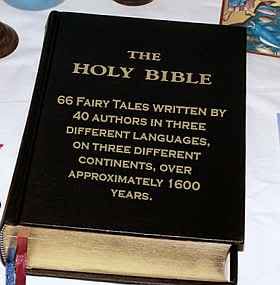
An example of the vehemence directed
at the Bible
The number one book on the revisionist's hit list; the greatest transgressor of offense and political incorrect subject matter; is the Bible.  What is the reason?  Slaves in the Bible were not solely of darker skin- They were of all different nationalities.  The youth of married women, perhaps?  This was a custom that held even one hundred years ago; however, with all fringe movements aside, the majority of modern Bible followers agree such a marriage to be damaging today.  Perhaps it is the warfare, adultery and bloodthirsty actions of the kings within the pages of the Bible?  How so, when one look at the reception that modern entertainment receives shows not a one victim of the same vehement vitriol as is directed at the Bible.  Not a one is demanded to undergo revision for "insensitivity."

So, what could be the cause of the spite and anger revisionists direct at this single text?  Why is the demand for revision not extended to books such as the Qur'an, or the Mack Bolan series?  Why are shows such as The Shield not dealing with the same call?  Why are movies such as 300, Pathfinder, or Sin City met with demand for more, rather than a wall of silence?  What about music by such bands as Slipknot or Cannibal Corpse?  What makes the Bible such an offensive book?

The only conclusion I've been able to reach, my friends, is that which rests in a common nickname for the Bible itself: "The Good Book."  It is the best sort of book, where every evil is punished; where every wicked deed is answered for; and wherein is found a solid, concrete code of moral conduct.  The Bible is the ultimate enemy of a society consumed by bad taste, because it is the ultimate good book.  Because it stands as the last unflinching standard of unwavering morality.  Because it reminds all who read it that there is a final judgment; that they are responsible for the actions carried out in bad taste, or against anything else contained in that moral code.

Because, as Voltaire so accurately observed, "a good book corrupts bad taste."